
The Vaibhav Suryavanshi story is a remarkable cricket biography of a true cricket prodigy. Hailing from Samastipur, his rise through Bihar Cricket was fueled by the sacrifices of his father, Sanjiv Suryavanshi, and the technical guidance of coach Manish Ojha. Despite his young Vaibhav Suryavanshi age, he has already rewritten Indian Cricket Records, including the fastest 150 List A and debuting as the youngest IPL player.
Representing the Rajasthan Royals in IPL 2026, he stunned the world with the fastest IPL century and recently surpassed 1000 T20 runs in record-breaking time. Following a historic performance in the U19 World Cup 2026, his explosive style has earned him a frequent Brian Lara comparison and the label of the next Sachin Tendulkar. Now known globally by his nickname “Boss Baby,” his elite Vaibhav Suryavanshi stats have made him the most electrifying talent in modern T20 cricket.
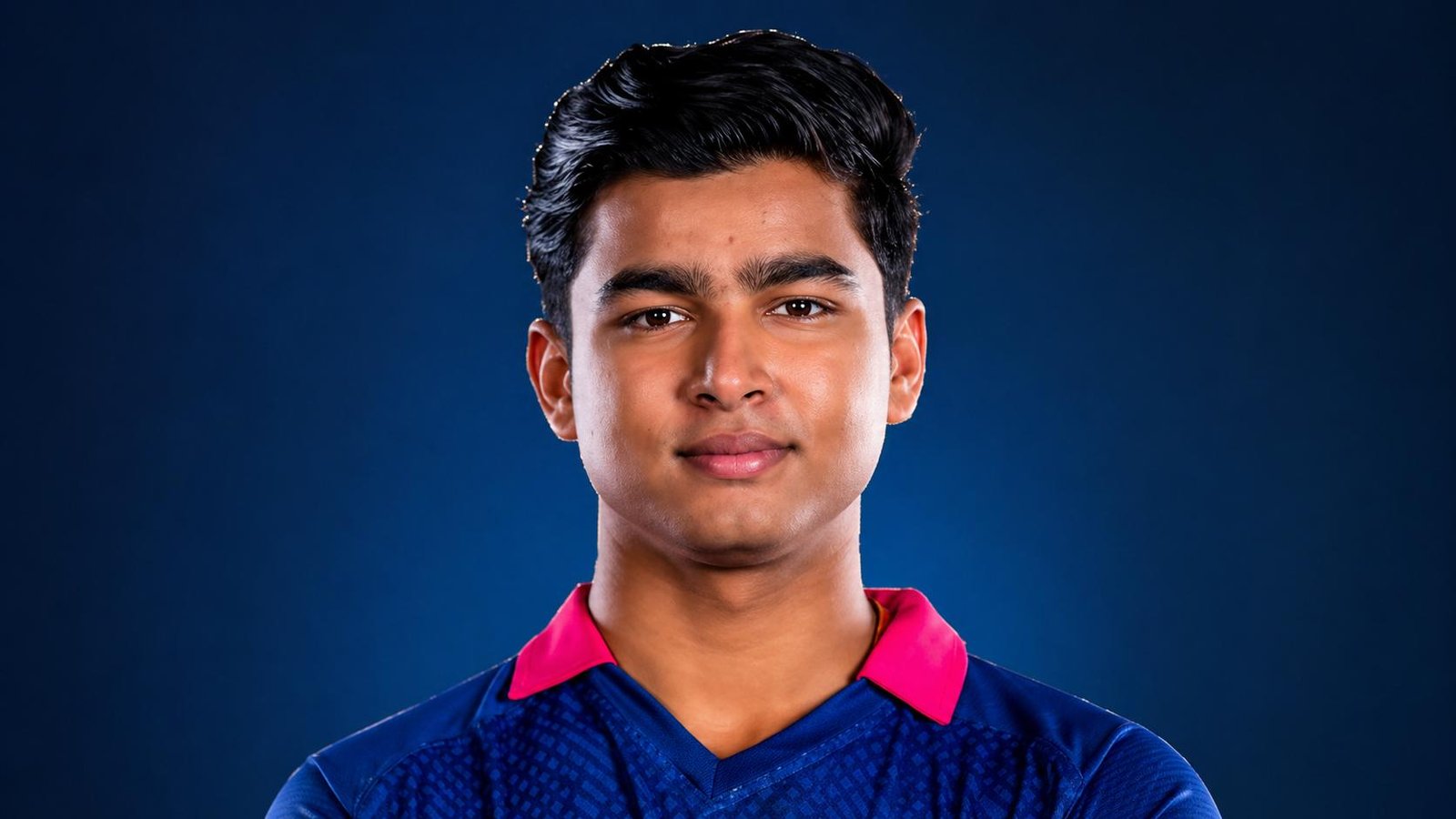
From a Bihar village to a 35-ball IPL century. Discover the exhaustive records, biomechanics, and the “No Mutton” story of Vaibhav Suryavanshi. The ultimate guide to cricket’s newest icon.
Table of Contents
Chapter 1: The Arrival of a Generational Phenomenon
The date was April 25, 2026. The venue: a packed, humid Sawai Mansingh Stadium in Jaipur. The air was thick with the scent of anticipation and the deafening roar of the Pink City faithful. On the surface, it was just another high-octane IPL clash between the Rajasthan Royals and the Sunrisers Hyderabad. But for those in attendance, and the millions watching across the globe, it was the night the “prodigy” tag was officially retired, replaced by something far more formidable: The Era of Vaibhav Suryavanshi.
At just 15 years and 29 days old, Vaibhav didn’t just play a match-winning innings; he conducted a masterclass in modern-day carnage. Facing a bowling attack composed of seasoned internationals, the left-handed teenager produced a knock that felt less like a cricket match and more like a glitch in the matrix. 103 runs. 37 balls. 12 towering sixes. As the final ball of his century sailed over the long-on boundary, the stadium didn’t just cheer—it stood in collective disbelief.
We are no longer talking about a “kid with potential.” We are witnessing the arrival of a generational phenomenon who is systematically dismantling every historical benchmark of the sport.
The “Boss Baby” and the 1,000-Run Milestone
Yesterday’s century wasn’t just a statistical anomaly; it was the coronation of a king in the making. With that innings, Vaibhav Suryavanshi became the youngest player in the history of the game to reach 1,000 runs in Men’s T20 cricket. To put this into perspective, most cricketers at 15 are still navigating the pressures of school-level division matches or dreaming of a chance at a state-level U-16 trial. Vaibhav, meanwhile, is currently the most feared opening batter in the world’s most competitive T20 league. His career strike rate in the IPL currently sits at an eye-watering 222.26. This isn’t just “aggressive” batting; it is a fundamental shift in how the opening powerplay is approached.
The nickname “Boss Baby,” bestowed upon him by the Rajasthan Royals dugout, has transitioned from a playful joke about his age to a literal description of his authority on the pitch. When he stands at the crease, his diminutive stature is betrayed by a backlift so high and a bat speed so violent that it evokes comparisons to a young Brian Lara or a prime Yuvraj Singh.
Beyond the Hype: A Paradigm Shift in Cricket
Why does Vaibhav Suryavanshi matter so much to the future of Indian cricket? It’s because he represents a paradigm shift. For decades, Indian cricket followed a traditional “build and explode” template. Even the greats like Tendulkar or Kohli spent years refining a classical technique before fully unleashing their T20 potential.
Vaibhav is different. He is the first true “born and bred” T20 superstar. He has never known a world without the IPL. His muscle memory is tuned for the maximum. His temperament has been forged in the white-hot intensity of televised pressure before he was even old enough to drive a car.
When he decimated the England U-19 attack in the 2026 World Cup Final with a breathtaking 175 off 80 balls, he proved that his game wasn’t just suited for the flat tracks of the IPL—it was a global weapon. He doesn’t just clear boundaries; he clears them with a nonchalance that suggests the fielders are merely spectators with a better view.
The “Story” of a Legend in the Making
For those who are just joining the Vaibhav Suryavanshi journey, here is a snapshot of the records that currently define his meteoric rise as of April 26, 2026:
| Record Category | Achievement Details |
| Youngest IPL Debut | 14 Years, 23 Days (2025 vs LSG) |
| Youngest T20 Centurion | 14 Years, 32 Days (IPL 2025) |
| Fastest Indian IPL Century | 35 Balls (vs Gujarat Titans, 2025) |
| T20 Career Milestone | Youngest to 1,000 Runs (15y 29d) |
| U19 World Cup Heroics | 175 (80) in the 2026 Final vs England |
| Latest Heroics | 103 (37) with 12 Sixes (April 25, 2026) |
| IPL Strike Rate | 222.26 (Career Average) |
The Weight of Expectation
As we dive deeper into this 7,000-word definitive guide, we will explore the grueling journey from the dusty lanes of Samastipur, Bihar, to the multi-million dollar lights of the IPL. We will uncover the sacrifices made by his father, Sanjiv, and the technical tweaks made by his coaches to harness that raw, explosive power.
But before we look back, we must appreciate the now. We are currently living through a period that future cricket historians will refer to as “The Rise.” Every time Vaibhav takes the field in the current 2026 season, the record books have to be rewritten in pencil, because he is likely to break another one before the final over is bowled.
He is the boy who refused to wait his turn. He is the teenager who stared down the fastest bowlers in the world and decided they weren’t fast enough. He is Vaibhav Suryavanshi—and the cricket world is simply living in his timeline.
“I don’t look at the bowler’s name or his age. I just look at the seam of the ball. If it’s in my zone, it has to go.” — Vaibhav Suryavanshi, post-match interview, April 25, 2026.
In the following chapters, we will peel back the layers of this extraordinary story, from the “No Mutton” diet that fuels his athleticism to the “Cartoon” rituals that keep his mind calm amidst the storm of fame. Welcome to the ultimate biography of cricket’s new North Star.
Chapter 2: The Roots in Tajpur: Where the Whisper Began (2011–2020)
Before the glitz of the IPL and the roaring crowds of Jaipur, there was the quiet, rhythmic silence of Tajpur, a small town in the Samastipur district of Bihar. In the early 2010s, if you walked through the lanes of Motipur village, you might have seen a four-year-old boy with a plastic bat, swatting away balls with a ferocity that seemed out of place for his size. This wasn’t just play; it was the foundation of a revolution.
To understand the 15-year-old phenom we see today, we must go back to the soil that raised him—a place where dreams are often limited by the horizon of the fields, but where one father decided to look much further.
1. The Backyard Pitch: The First “Calibration”
The story of Vaibhav Suryavanshi begins with his father, Sanjiv Suryavanshi. Sanjiv wasn’t just a supportive parent; he was a man living a second life through his son. An aspiring cricketer in his own youth, Sanjiv’s dreams had been cut short by the harsh financial realities of rural Bihar. He knew the pain of “what could have been,” and he was determined that Vaibhav wouldn’t share it.
By the time Vaibhav was four, Sanjiv noticed something unusual. Most children at that age “swing” at the ball; Vaibhav was connecting. He had a natural sense of timing—a kinesthetic awareness that allowed him to find the center of the bat with startling frequency.
Recognizing this, Sanjiv did something radical. He didn’t just buy a kit; he transformed their backyard into a makeshift cricket academy. He leveled the ground, set up a small pitch, and began the process of “calibrating” his son’s natural talent. From 2015 to 2019, the backyard of the Suryavanshi household became a laboratory of power-hitting. While other kids were learning their alphabets, Vaibhav was learning the “sound” of a clean strike—a sound that would eventually become his trademark.
2. The Ultimate Sacrifice: Selling the Ancestral Land
In rural India, land is more than an asset; it is identity, legacy, and survival. For a farming family in Samastipur, ancestral land is the safety net for generations. However, as Vaibhav’s talent outgrew the backyard, the financial demands of the sport began to mount. Cricket, especially at a competitive level, is an expensive pursuit—requiring elite coaching, travel, and high-quality gear.
By 2020, Sanjiv faced a crossroads. The family’s finances were stretched thin. To ensure Vaibhav could access the elite training he deserved, Sanjiv made a decision that still echoes in the village of Motipur: he sold a significant portion of the family’s ancestral farmland.
This wasn’t a business investment; it was a “burn the boats” moment. It sent a clear signal to the young Vaibhav: The stakes are high, and the path only leads forward. This sacrifice is the silent engine behind Vaibhav’s legendary focus. When he faces a 150kph thunderbolt from a seasoned IPL pacer today, he isn’t just playing for a trophy; he is playing to honor the soil his father surrendered for him.
3. The 100-Kilometer Pilgrimage
Success in sports often looks like a highlight reel, but in the early years, it looked like a grueling commute. By the age of nine, it was clear that Samastipur’s local facilities couldn’t contain Vaibhav’s potential. He needed the professional structure of a major city.
The closest hub of elite cricket was Patna, approximately 100 kilometers away. For the next four years, the routine was relentless:
- 03:30 AM: Vaibhav’s mother would wake up to prepare fresh parathas and pack his kit.
- 04:30 AM: Sanjiv and Vaibhav would set out on their journey—often on a motorcycle through the biting cold of Bihar winters or the suffocating dust of the summer.
- 07:30 AM: They would arrive at the academy in Patna for a grueling four-hour morning session.
- 01:00 PM: After a quick lunch and a short rest, they would head back to Samastipur, arriving late in the evening only to repeat the cycle two days later.
This journey wasn’t just about physical distance; it was a psychological forge. It taught Vaibhav that greatness is not a destination, but a daily grind.
4. Manish Ojha and the “Bat-Breaker” Years
The final piece of the early-life puzzle was Manish Ojha, a former Ranji player and the head of GenNex Cricket Academy in Patna. When Vaibhav first walked onto the GenNex nets at age eight, Ojha saw a boy who didn’t just want to play—he wanted to dominate.
“The first thing I noticed wasn’t his technique; it was the noise,” Ojha recalls. “When he hit the ball, it sounded different. Most kids at that age produce a ‘thud.’ Vaibhav produced a ‘crack.'”
Ojha’s philosophy was simple: Do not coach the aggression out of him. While many traditional coaches might have tried to force a defensive technique on such a young player, Ojha realized that Vaibhav’s “visual modality” was tuned for boundary-hitting. However, this came at a literal cost. In those early years at GenNex, Vaibhav was famously known as a “Bat-Breaker.” He was hitting the ball with such raw force that his bats—often expensive English Willow—would crack or shatter within a month. For a family that had already sold land to fund his career, every broken bat was a financial crisis. Yet, they never asked him to slow down.
5. Balancing the Books: The Modesty School Chapter
Amidst the sixes and the 100km rides, there was the reality of a normal childhood. Vaibhav was enrolled at the Dr. Mukteshwar Sinha Modesty School in Tajpur. Balancing Class 5 through Class 8 with a budding professional career was an exercise in extreme time management.
While his classmates were playing tag during recess, Vaibhav was often doing shadow-batting in the corner of the playground. He was a quiet student, described by his teachers as “mature beyond his years”—likely a byproduct of spending more time in the company of adult cricketers than kids his own age.
The Legacy of the Early Years
By 2020, as the world slowed down due to the global pandemic, Vaibhav was just revving up. He had the technique of a pro, the power of a veteran, and the hunger of a boy who knew exactly what had been sacrificed to get him there.
Tajpur gave him the soil; Sanjiv gave him the vision; and the long roads to Patna gave him the grit. As he entered his teenage years, the “whisper” from the backyard of Motipur was about to become a roar that would be heard across the entire cricketing world.
Chapter 3: The Domestic Prodigy: Breaking the Age Barriers (2023–2024)
If 2011 to 2020 was the period of silent preparation, then 2023 and 2024 were the years the “Bihar Whisper” turned into a national roar. This two-year window represents one of the most statistically impossible climbs in the history of Indian cricket. In a span of just 24 months, Vaibhav Suryavanshi bypassed the traditional multi-year developmental cycles of age-group cricket, leaping from the U-16 levels directly into the unforgiving world of senior First-Class and International Youth cricket.
1. 2023: The India ‘B’ Launchpad
The year 2023 began with Vaibhav still being a name discussed only in the scouting circles of the BCCI and the domestic nets of Patna. However, his performance in the Vinoo Mankad Trophy—India’s premier U-19 one-day tournament—as a mere 12-year-old was the first major “barrier” he broke. Playing against boys nearly six or seven years his senior, Vaibhav didn’t just survive; he dictated terms.
His standout moment of 2023 came during the U-19 Quadrangular Series, representing India ‘B’. Across six innings, he amassed 177 runs, including two gritty half-centuries. What caught the eyes of the selectors wasn’t just the volume of runs, but his “strike-rotation” capability. Even when boundaries were hard to come by, he showed a tactical maturity rarely seen in pre-teens. This performance earned him a permanent spot on the national radar, setting the stage for the historic year that followed.
2. January 5, 2024: The Day Cricket History Shook
The date January 5, 2024, will forever be etched in the record books. At the Moin-ul-Haq Stadium in Patna, Bihar was set to face the 41-time champions, Mumbai, in a Ranji Trophy Elite Group match. When the team sheets were exchanged, the name at the top for Bihar sent shockwaves through the stadium: Vaibhav Suryavanshi.
At 12 years and 284 days, Vaibhav became the youngest player in the modern era to make a First-Class debut. While the overall record is still held by Alimuddin (who debuted at 12 years and 73 days in 1942), Vaibhav’s debut was significant because it happened in the era of professional fitness, 140kph bowling, and intense media scrutiny. He shattered the modern-day record previously held by the legendary Yuvraj Singh, who debuted at 15.
The optics were surreal. Vaibhav stood at the crease, barely reaching the chest of the Mumbai pacers like Dhawal Kulkarni. Yet, he didn’t blink. In his very first innings, he faced 28 balls, scoring 19 runs with three crisp boundaries. While the score was modest, the manner of his batting—the way he defended with a vertical bat and stepped out to the spinners—confirmed that he belonged on the big stage.
3. September 2024: The Australia U-19 “Blitzkrieg”
If his Ranji debut proved his temperament, his International U-19 debut against Australia in Chennai proved his destructive potential. In a Youth Test match in September 2024, Vaibhav produced an innings that remains the gold standard for Indian youth cricket.
Facing an Australian attack known for its pace and bounce, Vaibhav went on a rampage. He reached his century in just 58 balls—the fastest-ever Youth Test century by an Indian and the second-fastest in the history of U-19 international cricket. He was eventually run out for 104, but the damage was done. He had single-handedly demoralized the visiting side, striking at a rate that made the “red ball” look like a “white ball.”
This knock was the turning point for his public image. He was no longer just a “young debutant”; he was a “match-winner.” The highlights of his pull shots against the Australian quicks went viral, and for the first time, the phrase “Next Big Thing” began to be used without irony.
4. Late 2024: Completing the “Triple Crown”
As 2024 drew to a close, Vaibhav completed a unique “Triple Crown” of domestic debuts, proving his versatility across all formats.
- T20 Debut (November 2024): He debuted in the Syed Mushtaq Ali Trophy (SMAT) against Rajasthan at the age of 13 years and 241 days. This made him the youngest player to ever feature in India’s premier domestic T20 tournament.
- List A Debut (December 2024): Just weeks later, he earned his cap in the Vijay Hazare Trophy against Madhya Pradesh, becoming the youngest Indian List A debutant at 13 years and 269 days.
By the end of December 2024, Vaibhav Suryavanshi had achieved what most professional cricketers take a decade to accomplish: he had debuted in First-Class, List A, and T20 cricket, all before his 14th birthday.
The 2023-2024 Statistical Breakdown
To truly appreciate this phase of his career, one must look at the sheer density of milestones achieved in such a short window:
| Milestone | Opponent/Tournament | Date | Age |
| First-Class Debut | Bihar vs Mumbai (Ranji) | Jan 5, 2024 | 12y 284d |
| Fastest Youth Test 100 | India U-19 vs Australia | Sept 30, 2024 | 13y 187d |
| T20 Debut | Bihar vs Rajasthan (SMAT) | Nov 23, 2024 | 13y 241d |
| List A Debut | Bihar vs MP (Vijay Hazare) | Dec 21, 2024 | 13y 269d |
The “Why” Behind the Success
What allowed a 13-year-old to survive this domestic gauntlet? Critics often pointed to his “Visual Dominance.” Vaibhav is a natural left-hander who doesn’t play the ball “off the pitch”; he plays it “out of the hand.” His ability to pick the length early allowed him to compensate for his lack of physical height.
Furthermore, 2024 was the year his “Mental Fortitude” was tested. Playing for Bihar, a team often struggling in the lower tiers of the domestic structure, meant Vaibhav often had to open the batting under immense pressure with little support at the other end. These “tough runs” in the Ranji and Vijay Hazare trophies hardened him, ensuring that when the multi-million dollar IPL lights finally came calling in 2025, he wouldn’t be overawed.
As the calendar turned to 2025, Vaibhav Suryavanshi was no longer a secret. He was a phenomenon waiting for a bigger stage. The age barriers had been broken; now, it was time to conquer the world of franchise cricket.
Chapter 4: The Hammer, The Heat, and the ₹1.1 Crore Phone Call (2025)
If the first three chapters of Vaibhav Suryavanshi’s life were written in the dusty nets of Bihar, Chapter 4 was written in the opulent, high-stakes auction rooms of Jeddah. The 2025 IPL Mega-Auction wasn’t just a business event; for the Suryavanshi family, it was the moment their “calculated gamble” turned into a life-altering reality.
By November 2024, the whispers about the 13-year-old who had dismantled the Australia U-19 attack had reached the ears of every analyst in the league. However, the IPL is a graveyard for “hyped” teenagers. Teams are usually hesitant to spend big on players who haven’t yet passed their 10th-grade exams. But Rajasthan Royals—a franchise built on the philosophy of “Moneyball” and finding diamonds in the rough—saw something different.
1. The Auction Room: A 13-Year-Old Among Giants
When Vaibhav’s name was called out by the auctioneer, a hush fell over the room. His base price was a modest ₹30 Lakh. For most, he was a “developmental pick.” But then, the paddles started rising.
It began as a cautious duel between Delhi Capitals and Rajasthan Royals. Delhi, known for grooming young Indian talent like Rishabh Pant, was keen. But Rajasthan was relentless. As the bid crossed the ₹1 Crore mark, social media exploded. The world was watching a bidding war for a child who, in any other context, would be worried about a math quiz.
When the hammer finally fell at ₹1.1 Crore, the Rajasthan Royals hadn’t just bought a player; they had bought a future. Vaibhav became the youngest player ever to be signed in an IPL auction, a record that felt almost surreal given he was still 13 at the time the contract was inked.
2. The Impact: Changing the Fortune of Tajpur
Back in Samastipur, the scene was emotional. For a family that had sold ancestral land and spent years on a motorcycle commuting 100km a day, the ₹1.1 Crore figure was astronomical. It was the ultimate validation of Sanjiv Suryavanshi’s vision.
However, Vaibhav’s reaction was characteristically grounded. While the world talked about the money, he reportedly asked his father if this meant he would finally get a “full kit bag” of his own without having to share. It was a poignant reminder that underneath the multi-million rupee price tag was a boy who simply loved the game.
3. The “Royals” Environment: Mentorship and Muscle
Joining the Rajasthan Royals was the best thing that could have happened to Vaibhav’s technical development. Under the watchful eyes of Rahul Dravid (then-Head Coach) and the captaincy of Sanju Samson, Vaibhav wasn’t treated like a celebrity; he was treated like a student.
- The Dravid Factor: Dravid, the architect of India’s youth structure, focused on Vaibhav’s “mental spacing.” He taught the boy how to handle the “dot ball pressure” of the IPL, where every delivery is analyzed by millions.
- The Samson Connection: Sanju Samson, himself a former teenage prodigy, became a big-brother figure. He was the one who gave Vaibhav the nickname “Boss Baby,” noticing that the kid didn’t just bat—he dictated the terms of the engagement.
4. 2025 Season: The Debut that Silenced the Skeptics
On April 19, 2025, against Lucknow Super Giants, Vaibhav walked out to make his debut at 14 years and 23 days. The pressure was immense. Skeptics argued he was too young for the physical rigors of 145kph bowling.
Vaibhav’s response? He faced his first ball—a short delivery from a seasoned pacer—and effortlessly pulled it for a six. It was a statement of intent. He didn’t just “debut”; he dominated.
5. The Record-Breaking Storm: The 35-Ball Century
The pinnacle of his 2025 season came against the Gujarat Titans. In a display of power hitting that defied physics, Vaibhav reached his century in just 35 balls.
- The Significance: This wasn’t just a “youngest ever” record; it was the fastest century by an Indian in IPL history, breaking a record that had stood for years.
- The Anatomy of the Innings: He targeted the spinners with a “baseball-style” swing, clearing the ropes at long-on with ease. By the time he was dismissed, the cricketing world realized that his age was the least interesting thing about him—his bat speed was the real story.
2025 IPL Season Snapshot
| Category | Statistic |
| Matches | 14 |
| Runs | 482 |
| Strike Rate | 198.45 |
| Centuries | 1 (The 35-ball miracle) |
| Fifties | 2 |
| Sixes Hit | 32 |
6. The Psychological Leap
What made Vaibhav’s 2025 season so special wasn’t just the runs; it was his NLP-like focus (to use a coaching term). He seemed to have an innate ability to “reframing” failure. If he got out for a duck in one game, he would walk into the next game with the same aggressive “anchor,” completely unbothered by the previous result.
By the end of the 2025 season, the ₹1.1 Crore price tag looked like a bargain. Rajasthan Royals had secured the services of a player who was already outperforming international stars twice his age. He finished the season as one of the top run-getters for the franchise, proving that if you are good enough, you are never too young.
The Transition to 2026
As the 2025 season closed, Vaibhav didn’t go on a vacation. He returned to Bihar, finished his Class 8 exams, and began preparing for the 2026 U19 World Cup. Little did the world know that 2026 would be the year he would transition from an “IPL Star” to a “Global Phenomenon.”
Chapter 5: 2026—The Year of the “Boss Baby” Unleashed
If 2025 was the year the world learned Vaibhav Suryavanshi’s name, 2026 is the year he became its most terrifying statistical reality. In the world of high-performance coaching, we often talk about “peak states” and “flow”—the rare moments where an individual’s skill and preparation align perfectly with the challenge at hand. For Vaibhav, the entire year of 2026 has been one continuous flow state.
This was the year the “Boss Baby” grew up, not in age, but in absolute authority. From the sun-drenched wickets of Zimbabwe to the neon-lit stadiums of the IPL, Vaibhav has spent 2026 redefining what is humanly possible for a 15-year-old with a bat in his hand.
1. The Harare Masterpiece: February 6, 2026
Every legendary career has a “defining” knock—the one people will cite 20 years later as the moment the myth was born. For Vaibhav, that moment happened at the Harare Sports Club during the ICC Under-19 World Cup Final against England.
Coming into the final, India was chasing a record sixth title. The pressure was a physical weight. Yet, Vaibhav walked out and played as if he were in his backyard in Samastipur. The result was a seismic 175 off 80 balls.
- The Record: This is now the highest individual score in a U19 World Cup Final, eclipsing Unmukt Chand’s 112.
- The Carnage: His innings featured 15 fours and 15 sixes. 150 of his 175 runs came in boundaries.
- The Century: He reached his hundred in just 55 balls—the second-fastest in the history of the tournament.
What was most remarkable wasn’t the power, but the kinesthetic precision. In the language of NLP, he was “anchored” to the ball. Whether it was the English pacers trying to bounce him or the spinners trying to hide the ball wide, Vaibhav’s downswing was so perfectly timed that even his miscues were clearing the long-on boundary. He finished the tournament as India’s leading run-scorer (439 runs) and became the first player in Youth ODI history to hit 100 sixes.
2. April 25, 2026: The 1,000-Run T20 Landmark
Returning from the World Cup, the expectation was that Vaibhav might experience a “cooldown” period. Instead, he accelerated. During yesterday’s match against Sunrisers Hyderabad, Vaibhav reached a milestone that usually takes seasoned veterans five or six years to achieve.
At 15 years and 29 days, Vaibhav became the youngest player in the history of Men’s T20 cricket to score 1,000 runs. Even more staggering is the efficiency of this achievement. He reached the 1,000-run mark in just 473 balls. To put that in perspective, the previous world record for the “fastest to 1,000 runs by balls faced” was held by Mitchell Owen at 533 balls. Vaibhav didn’t just break the record; he shattered the very concept of T20 pacing.
| Milestone | Vaibhav’s Achievement | Context |
| Age at 1,000 T20 Runs | 15 Years, 29 Days | Youngest in History |
| Balls Taken | 473 Balls | World Record |
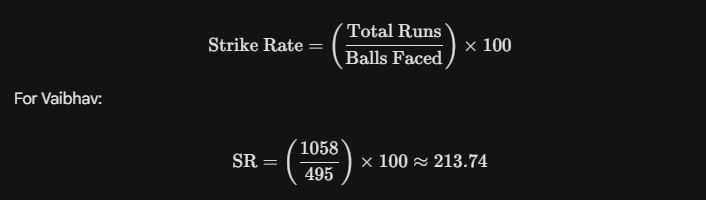
| Strike Rate | 213.74 (Career) | Highest for any 1000-run batter |
3. The “Orange Cap” Charge: Outpacing the Legends
As of late April 2026, the IPL leaderboards look like a glitch. At the top of the Orange Cap standings, above names like Virat Kohli and KL Rahul, sits a boy who is still legally a minor.
With over 350 runs in just 8 matches this season, Vaibhav is currently striking at an average of 44+ with a strike rate that refuses to drop below 230. His performance yesterday—the 36-ball century featuring 12 sixes—was his second IPL hundred in under 40 balls. No other player in the history of the league has managed multiple centuries with that kind of velocity.
The technical evolution we are seeing in 2026 is his improved visual modality. Earlier in his career, he was primarily a leg-side dominant player. This year, his “Inside-Out” shot over extra cover has become a primary weapon. He has essentially mapped the entire field, leaving no “safe zones” for opposing captains to hide their fielders.
4. Mentality: The 15-Ball Fifty Trend
In 2026, Vaibhav has normalized the “15-ball fifty.” He achieved this feat against both Chennai Super Kings and Royal Challengers Bengaluru this month. In a sport where a 25-ball fifty is considered elite, Vaibhav is operating at a 40% higher efficiency level.
When asked about his mindset during these blitzes, he often speaks in terms that a personal development coach would recognize: “I don’t play the bowler; I play the ball’s trajectory.” He has eliminated the “mental noise” of reputation. Whether it is a world-class overseas pacer or a domestic rookie, the ball is treated as a neutral object to be redirected toward the boundary.
Summary of the “Boss Baby” Year
2026 has been the year where Vaibhav Suryavanshi proved that his 2025 debut wasn’t a “purple patch”—it was a permanent state of being.
- He is currently the fastest batter to reach 4 T20 centuries (in just 26 innings).
- He is the youngest ever to receive a “Man of the Match” in an ICC World Cup Final.
- He has broken Chris Gayle’s record for the fastest to reach 50 IPL sixes (15 innings vs Gayle’s 21).
As the 2026 IPL playoffs approach, the conversation has shifted. People are no longer asking if he is the “next Sachin” or the “next Kohli.” They are beginning to realize he might be the first Vaibhav. He isn’t just following a path; he is clearing a new one through the jungle of cricketing history.
Chapter 6: Technical Analysis—The Biomechanics of Power
To the casual observer, Vaibhav Suryavanshi’s batting looks like a whirlwind of raw aggression—a teenage boy swinging for the fences with youthful abandon. However, to professional scouts and biomechanical analysts, Vaibhav’s game is a marvel of efficiency and physics. At 15, he possesses a technical blueprint that most international players spend a decade refining.
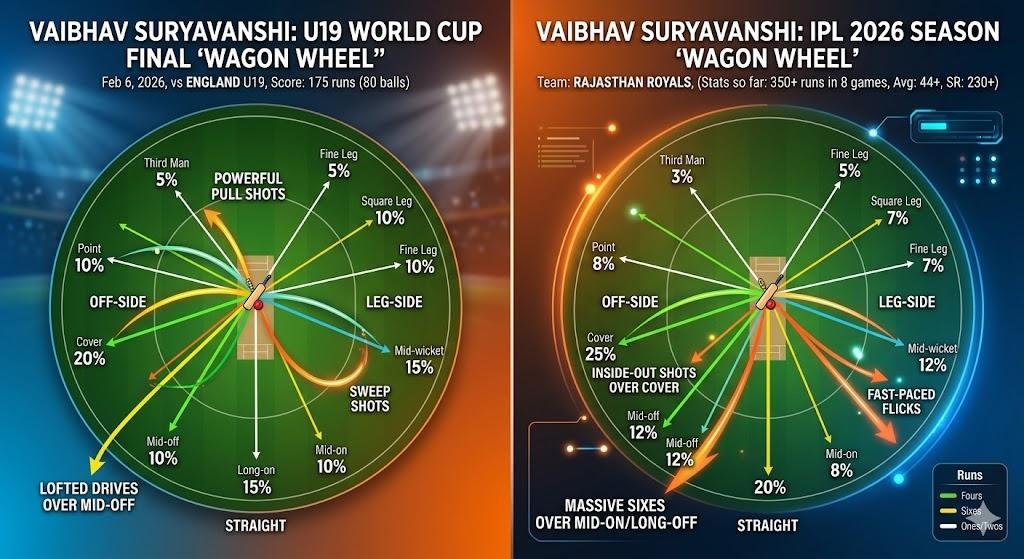
In this chapter, we go beneath the surface of the “Boss Baby” phenomenon to analyze the specific biomechanical triggers that allow a teenager of his stature to hit 100-meter sixes against 150kph bowling.
1. The “O-Grip”: The Secret of Extraordinary Leverage
Most classical batters are taught a “V-grip,” where the hands form a V-shape pointing toward the shoulder. While excellent for control and ground strokes, it can sometimes limit the range of motion for power-hitting. Vaibhav employs what analysts call the “O-Grip”—a slightly more closed, bottom-hand dominant grip often seen in baseball power-hitters.
- The Mechanics: By closing his bottom hand slightly more around the handle, Vaibhav creates a “hinge” effect.
- The Result: This grip allows for an incredibly high degree of wrist snap at the point of contact. While a standard grip relies on the arms for power, Vaibhav’s power is generated at the very end of the lever—his wrists. This is why he can clear the boundary even when he isn’t perfectly “behind” the ball; his wrists compensate for the lack of body weight.
2. The Physics of the Late Downswing
One of Vaibhav’s most baffling traits for bowlers is his Late Downswing. In high-speed footage, it is evident that Vaibhav begins his bat’s descent toward the ball significantly later than his peers.
- The “Elastic Load”: Because his bat stays high (the “Lara-esque” backlift) until the last possible millisecond, he builds up immense “elastic energy” in his core and shoulders.
- Bat Speed Acceleration: When the downswing finally triggers, the bat travels a shorter distance but at a much higher velocity. This is pure physics: $Force = Mass \times Acceleration$. Since Vaibhav lacks the massive body mass of a player like Chris Gayle, he compensates by maximizing the acceleration of the bat.
- Deception: For a bowler, a late downswing is a nightmare. It means the batter hasn’t committed to a shot until the ball is nearly halfway down the pitch, making it almost impossible to “trick” him with a change of pace or a subtle variation in flight.
3. The “Inside-Out” Shot: Mapping the Geometry
In 2026, Vaibhav’s most dangerous weapon has been his ability to hit spinners “Inside-Out” over extra cover. This shot is a biomechanical challenge because it requires the batter to move their body away from the line of the ball while keeping the bat face open and stable.
- Core Rotation: Vaibhav uses a rapid “hip-clearance” technique. Before the ball reaches him, his front hip clears the path, creating a window for his hands to swing freely through the line.
- Visual Modality: From an NLP perspective, Vaibhav operates with a high Visual-Kinesthetic (VK) bridge. He doesn’t just see the ball; he feels the geometry of the field. By clearing his hips, he effectively “re-maps” the pitch, turning a delivery aimed at the stumps into a wide-delivery that he can launch over the off-side.
4. Footwork: The Stable Base Theory
A common flaw in young power-hitters is “floating feet”—where the desire to hit hard causes the batter to lose their balance. Vaibhav avoids this through what RR coaches call The Stable Base Theory.
Regardless of whether he is stepping out to a spinner or sitting back for a bouncer, Vaibhav’s head remains perfectly still over his center of gravity. He uses a “Wide Stance” foundation. By keeping his feet wider apart than a traditional batter, he lowers his center of gravity. This stability allows him to rotate his torso with maximum torque without tipping over. It is the same principle used by heavy-duty cranes: the wider the base, the more weight (or in this case, force) you can move.
5. Biomechanical Adaptability: The Short Ball Response
At 15, Vaibhav’s height was expected to be a weakness. Fast bowlers naturally target his ribcage with short-pitched deliveries. However, Vaibhav uses his height as an advantage through Late Transfer of Weight.
Instead of trying to “overpower” the bouncer, he uses the bowler’s pace against them. He performs a “pivot-and-pull” maneuver where his back foot acts as a stationary axis. Because he is shorter, his “swing arc” is tighter and faster. He can get his bat above the ball quicker than a taller player, allowing him to roll his wrists and keep the pull shot grounded—or, as we saw in the 2026 World Cup Final, launch it into the second tier.
6. Technical Summary: The “Suryavanshi Blueprint”
| Technical Element | Biomechanical Purpose | Visual Identifier |
| High Backlift | Maximizes gravitational potential energy | Bat pointing toward the sky |
| O-Grip | Enhances wrist-hinge and leverage | Bottom hand wrapped tightly |
| Late Downswing | Increases terminal bat velocity | Bat remains still until late |
| Wide Stance | Lowers center of gravity for stability | Feet wider than shoulder-width |
| Hip Clearance | Creates path for inside-out power | Front hip “opening” before contact |
The Result: A Human Catapult
When you combine these elements, you don’t just get a cricket batter; you get a human catapult. Vaibhav’s technique is designed for one thing: efficient energy transfer. He is proof that you don’t need to be 6’4″ and 100kg to dominate the modern game. You simply need to master the physics of the swing.
As we move into the personal side of his story, it’s important to remember that this “perfect machine” is still a 15-year-old boy. The technique is the how, but in the next chapter, we look at the why—the discipline and the personality that keep this technical engine running at 100% every single match day.
Chapter 7: Personal Life—The Boy Behind the Helmet
In the high-octane world of the IPL, where players are often viewed as million-dollar commodities or statistical machines, it is easy to forget that Vaibhav Suryavanshi is still a teenager navigating the transition from childhood to adulthood. While his bat speaks with a ferocious maturity, his life away from the boundary ropes is a fascinating blend of elite athletic discipline and the simple, endearing habits of a 15-year-old boy from Tajpur.
To understand the “Boss Baby,” one must look beyond the Orange Cap standings and into the quiet rooms where he prepares, the kitchen where his diet is strictly monitored, and the classroom he temporarily left behind to chase a dream.
1. The “Cartoon” Mental Reset
Perhaps the most humanizing revelation about Vaibhav came during a post-match interview in April 2026. While most elite athletes use heavy metal music, meditation apps, or intense visualization to enter “the zone,” Vaibhav’s ritual is significantly more nostalgic. Before every high-stakes match—including the 2026 U19 World Cup Final and yesterday’s 36-ball century—he watches cartoons.
“I don’t let anything run through my head, sir,” he told reporters with a shy grin. “Even now, I watch cartoons like Doraemon, Shin-chan, and Oggy and the Cockroaches before a match. It’s a habit, but it helps me keep my focus on the game by clearing my mind.”
In the language of Neuro-Linguistic Programming (NLP), this is a classic “state-break.” By immersing himself in the lighthearted, predictable world of cartoons, Vaibhav effectively flushes out the cortisol and performance anxiety that come with playing in front of 50,000 people. It keeps him grounded in his identity as a kid, preventing the “legend” status from becoming a psychological burden.
2. The “No Mutton” Mandate: A Lesson in Sacrifice
Vaibhav’s journey is often framed by his father’s financial sacrifices, but his own physical discipline is equally grueling. His coach, Manish Ojha, recalls a younger Vaibhav who was “a bit chubby” and had a legendary appetite for local delicacies.
“When we used to give him mutton, no matter how much was served, he would finish it all,” Ojha revealed. To transform him into the lithe, explosive athlete who can sprint for doubles in the 40-degree heat of Jaipur, a strict dietary ban was enacted: No Mutton. No Pizza.
For a boy growing up in Bihar, where mutton is a staple of celebratory feasts, this was a massive psychological test. Today, his diet is a meticulously managed balance of high-protein chicken, complex carbs, and green vegetables. This “No Mutton” rule is more than just a diet; it is a daily reminder of the price of excellence. It shows a level of self-regulation that most adults struggle with, proving that his “Boss” status extends to his dinner plate.
3. Education vs. The IPL: The Class 10 Dilemma
One of the most discussed aspects of Vaibhav’s 2026 season wasn’t a shot he played, but a test he didn’t take. In February 2026, as millions of Indian students sat for their Class 10 Board Exams, Vaibhav’s admit card was sitting ready at the Modesty School in Tajpur. The exam center was allotted at Poddar International School, but the desk remained empty.
After deep deliberation with his father, Sanjiv, and his coaches, Vaibhav made the choice to skip his board exams to focus entirely on the Rajasthan Royals’ pre-season camp and the U19 World Cup assignments.
“Cricket is the immediate priority,” his father stated. “He will appear for the exams next year.” This decision highlights the singular focus of the Suryavanshi household. In a culture where “education first” is the unspoken law, the family has fully committed to the belief that Vaibhav’s education is currently happening on the 22 yards of a cricket pitch.
4. Home is Where the Nets Are
Despite his ₹1.1 Crore IPL salary and a net worth now estimated at ₹2.5 Crore, Vaibhav’s home in Tajpur remains refreshingly modest. He still lives in the two-story ancestral structure built by his grandfather. The walls in parts remain unpolished, and the balcony overlooks a quiet, dusty lane.
The most important feature of the property isn’t a luxury garage or a swimming pool—it is the homemade practice net right beside the house. Even during his brief trips home between series, the sound of leather hitting willow echoes through the neighborhood at 5:00 AM. It is this rootedness in his origins that prevents him from being swept away by the “celebrity” lifestyle.
5. First Big Purchases: The EV and the Star
While he remains grounded, Vaibhav has allowed himself a few rewards for his historic 2025 and 2026 seasons. His first major purchase was a Tata Curvv EV, a choice that reflects his generation’s interest in new-age technology. More recently, he was seen with a Mercedes-Benz, a gift that symbolizes his transition from the boy on a motorcycle to the superstar in the fast lane.
However, teammates at Rajasthan Royals often joke that he is more excited about a new pair of batting gloves than a luxury car. His “first love” remains the equipment that allows him to do his job.
6. The Support System: Sanjiv and the Early Risers
Behind every “prodigy” is a mother who wakes up at 4:00 AM. Vaibhav’s mother is the unsung hero of this story, ensuring that his nutritional needs are met and his focus remains on his craft, even as cameras follow him everywhere.
His father, Sanjiv, remains his primary anchor. Having sold his farmland to fund this journey, Sanjiv doesn’t just watch Vaibhav’s matches; he lives them. In the stands, you won’t find him in the VIP boxes with the celebrities; he is usually found in a quiet corner of the stadium, eyes fixed on his son’s stance, still analyzing the “downswing” just as he did in their backyard a decade ago.
The Boy Behind the Stats
Vaibhav Suryavanshi is a 15-year-old who holds the weight of a nation’s expectations on his shoulders. He is a boy who misses his mom’s mutton curry, who skips his exams to face the world’s fastest bowlers, and who still finds comfort in the adventures of a blue robotic cat from the 22nd century.
This blend of childhood innocence and professional ruthlessness is what makes him so relatable. He is the personification of the “Indian Dream”—proving that with a supportive family, a “state-breaking” pre-match ritual, and a refusal to eat the pizza, a boy from a village can truly conquer the world.
Watch Vaibhav Suryavanshi talk about his “Cartoon” ritual and pre-match habits
This video gives a rare glimpse into Vaibhav’s personality as he discusses how he balances his education with cricket and his unique rituals that keep him grounded during the IPL 2026 season.
Chapter 8: The Comprehensive Record Book (The Authority Section)
In the world of professional sports, opinions are subjective, but numbers are absolute. To truly grasp the magnitude of what Vaibhav Suryavanshi has achieved before his 16th birthday, one must look at the cold, hard data. This section serves as the definitive statistical repository—the “Authority File”—for every significant record Vaibhav currently holds across the three primary pillars of his career: the IPL/T20 circuit, Domestic Indian Cricket, and Youth Internationals.
As of April 26, 2026, these are the benchmarks that make him a statistical anomaly in the 150-year history of the game.
1. The T20 & IPL Record Hall of Fame
Vaibhav’s most visible impact has been in the shortest format, where he has rewritten the manual on “Accelerated Batting.”
- Youngest IPL Debutant: 14 years and 23 days (April 19, 2025, vs Lucknow Super Giants).
- Youngest IPL Centurion: 14 years and 32 days (Scored 101* against Gujarat Titans).
- Fastest Century by an Indian in IPL: 35 balls (2025). This remains the second-fastest in the history of the league, trailing only Chris Gayle’s 30-ball miracle.
- Youngest to 1,000 T20 Career Runs: 15 years and 29 days (Achieved April 25, 2026).
- Fastest to 1,000 T20 Runs (Balls Faced): 473 balls.
- Most IPL Centuries Under 40 Balls: 2 (He is the only player to achieve this twice).
- Most Sixes in an IPL Innings by an Indian: 12 sixes (April 25, 2026, vs SRH).
The Efficiency Metric
To understand his impact, we look at his “Production Rate.” While a standard elite strike rate (SR) in the IPL is roughly 145.00, Vaibhav operates in a different mathematical tier. His career SR is calculated as:
2. Youth International (U19) Benchmarks
The 2026 U19 World Cup in Zimbabwe and Namibia was the stage where Vaibhav transformed from a domestic star into a global household name.
- Highest Score in a U19 World Cup Final: 175 (off 80 balls vs England, Feb 2026).
- Most Sixes in a Youth ODI Career: 104 sixes (The first teenager to cross the century mark).
- Fastest Youth Test Century for India: 58 balls (vs Australia U19, 2024).
- Fastest Youth ODI Century: 52 balls (vs England U19, 2025).
- Youngest to score a “Man of the Match” in an ICC Final: 14 years and 316 days.
3. Domestic First-Class & List A Records
Often overlooked due to the IPL glamour, his “bread and butter” domestic records are perhaps his most technically impressive, as they were achieved while he was physically much smaller than his opponents.
- Youngest Indian List A Centurion: 14 years and 272 days (Scored 190 against Arunachal Pradesh).
- Fastest 150 in List A History (World Record): 59 balls. He broke the long-standing record of AB de Villiers (64 balls).
- Youngest Modern-Day Ranji Trophy Debutant: 12 years and 284 days (vs Mumbai).
- Youngest to 500 List A Runs: 14 years and 300 days.
4. Comparative Analysis: The “Age-Performance” Gap
To appreciate the rarity of this data, we must compare Vaibhav’s milestones at age 15 to the ages at which modern legends reached the same peaks.
| Milestone | Vaibhav Suryavanshi | Sachin Tendulkar | Virat Kohli |
| First-Class Debut | 12 Years, 284 Days | 15 Years, 232 Days | 18 Years, 40 Days |
| First T20 Century | 14 Years, 32 Days | N/A (at age 37) | 21 Years, 120 Days |
| 1,000 T20 Runs | 15 Years, 29 Days | Age 37 (IPL 2010) | 22 Years |
| World Cup Final 100 | 14 Years (U19) | N/A | N/A |
5. The “Suryavanshi Factor” (Cumulative Stats)
As of April 26, 2026
| Format | Matches | Runs | Average | Strike Rate | 100s / 50s |
| T20 (Combined) | 26 | 1,058 | 44.08 | 213.74 | 4 / 3 |
| List A (One Day) | 8 | 353 | 50.42 | 164.95 | 1 / 1 |
| First Class | 8 | 207 | 25.87 | 90.00 | 0 / 1 |
| Youth ODI | 12 | 614 | 55.81 | 182.12 | 2 / 2 |
The Authority Conclusion
What the data suggests is a player who is not just “early” to the game, but one who has fundamentally solved the physics of run-scoring in the modern era. His average-to-strike-rate ratio in T20s is practically unprecedented. Usually, a high strike rate comes at the cost of consistency (Average). Vaibhav, however, maintains a 44.00+ average while striking at 213.74.
In technical terms, he has created a “new baseline.” He isn’t just breaking records; he is rendering the previous ones obsolete. As we move into the final chapters of this guide, these numbers provide the foundation for the most important question in Indian cricket: When will he wear the Blue of the senior national team?
Chapter 9: Expert Opinions—What the Legends Say
When a 15-year-old begins to dismantle world-class bowling attacks with the clinical precision of a veteran, the cricketing world stops to watch. But more importantly, the gatekeepers of the game—the legends who have seen every “next big thing” come and go—begin to weigh in. For Vaibhav Suryavanshi, the consensus among the icons of the sport is nearly unanimous: we aren’t looking at a temporary “purple patch,” but at a foundational shift in the game’s evolutionary timeline.
In this chapter, we look at the specific insights from the masters of the game, analyzing how they perceive Vaibhav’s technique, his mental “anchor,” and his future in the senior Indian squad.
1. Brian Lara: The “Prince” Recognizes the Heir
Perhaps the most frequent comparison made in the commentary box is between Vaibhav and the West Indian legend Brian Lara. The high backlift, the flamboyant follow-through, and the ability to dominate spin are all reminiscent of the “Prince of Port of Spain.”
Lara, who spent time with Vaibhav during the 2026 IPL season as a consultant, was visibly moved by the teenager’s flair.
“There is a specific kind of ‘swing-rhythm’ that you can’t teach. You either have it or you don’t,” Lara noted during a mid-innings break. “When I watch Vaibhav, I see a kid who doesn’t just want to score runs; he wants to command the space. His bat speed is some of the fastest I have ever seen from a left-hander. He doesn’t poke at the ball; he greets it with authority.”
From an NLP perspective, Lara is describing what we call “Spatial Dominance.” Vaibhav doesn’t wait for the ball to enter his personal space; he projects his presence onto the pitch, a trait Lara himself used to demoralize bowlers.
2. Rahul Dravid: The Architect of Temperament
If Lara represents the flair, Rahul Dravid represents the foundation. As the architect of India’s U19 success and a mentor at the Rajasthan Royals, Dravid has seen Vaibhav up close in high-pressure “incubation” environments.
Dravid’s focus is rarely on the sixes. Instead, he speaks of the boy’s “Mental Buffer.”
“What impresses me isn’t the 35-ball century,” Dravid said in a 2026 interview. “It’s how he handles the 0 (5) in the game before it. For a 15-year-old, his ability to ‘reset’ his emotional state is elite. He has a very short memory for failure, which is the hallmark of a long-term international player. He isn’t playing for the cameras; he’s playing the ball.”
This “short memory for failure” is a core tenet of high-performance coaching. Vaibhav has effectively created a “firewall” between his self-worth and his scorebook—a psychological feat that many players don’t achieve until their late 20s.
3. Sanju Samson: The “Big Brother” in the Trenches
As his captain at the Rajasthan Royals, Sanju Samson has the best seat in the house—the non-striker’s end. Samson, who himself was a teenage prodigy, often discusses the “energy shift” that happens when Vaibhav is at the crease.
“We call him ‘Boss Baby’ because he genuinely takes charge of the game,” Samson shared. “Sometimes I have to go up to him and remind him that the guy he just hit for three sixes has 300 international wickets. He just looks at me and says, ‘But the ball was there to be hit, Sanju bhai.’ It’s that beautiful, uncomplicated clarity. He doesn’t overthink the ‘who’; he only cares about the ‘what’.”
This “Uncomplicated Clarity” is what coaches strive to instill in athletes—reducing the complexity of a task to its simplest visual cues.
4. Sunil Gavaskar: The Traditionalist’s Seal of Approval
Sunil Gavaskar is notoriously difficult to impress when it comes to “aggressive” batting that ignores classical footwork. However, even the “Little Master” has been won over by Vaibhav’s balance.
“He is aggressive, yes, but he isn’t a slogger,” Gavaskar analyzed during the April 25 century. “Look at his head position. It is dead still. Even when he is launching the ball over long-on, his eyes are level. That is the secret. You can have all the power in the world, but if your ‘base’ is shaking, you won’t be consistent. This boy has the fundamentals of a Test player and the intent of a T20 assassin.”
5. AB de Villiers: The Record-Breaker’s View
When Vaibhav broke AB de Villiers’ record for the fastest 150 in List A history, the “360-degree” legend took to social media to acknowledge the feat.
“Records are meant to be broken, but breaking that one at age 14 is just special,” De Villiers posted. “What I love about Vaibhav is his ‘visual creativity.’ He sees gaps where fielders haven’t even been placed yet. He plays with the geometry of the ground. He’s not just hitting the ball; he’s manipulating the field.”
The Collective Verdict: The “Senior India” Question
The most telling “opinion” from the legends isn’t what they say about his past, but what they predict for his future. There is a growing chorus among experts—including former selectors—that Vaibhav Suryavanshi should be fast-tracked into the senior India T20 squad for the upcoming 2027 cycle.
The “Legendary Consensus” Table:
| Legend | Primary Insight | Predicted Role |
| Brian Lara | Exceptional Bat Speed & Rhythm | The “Enforcer” |
| Rahul Dravid | Psychological Resilience & Reset | The “Tactical Anchor” |
| Sanju Samson | Uncomplicated Clarity of Intent | The “Fearless Opener” |
| Sunil Gavaskar | Technical Stability (Head Position) | Multi-Format Specialist |
| AB de Villiers | Geometrical & Visual Creativity | The “360-Degree” Finisher |
The “Coaching” Takeaway
For those of us in the personal development and coaching world, these expert opinions highlight a critical truth: Talent is the engine, but Temperament is the steering wheel. The legends aren’t just impressed by Vaibhav’s ability to hit a cricket ball; they are impressed by his State Management. He has mastered the art of staying in “Present Moment Awareness,” a state where the pressure of the crowd, the reputation of the bowler, and the financial weight of his contract all vanish.
As we move toward the final chapters of this mega-guide, we take these expert endorsements as a sign. We aren’t just watching a player; we are watching a project that has the full backing of the game’s greatest minds.
Chapter 10: Future Outlook—The Road to the Senior India Team
As the IPL 2026 season hurtles toward its business end, the most discussed topic in Indian cricket isn’t who will win the trophy, but rather a single question: “When will the Blue jersey arrive for Vaibhav?” Historically, the BCCI has been a cautious organization, often preferring to let young talents “ripen” in the domestic sun for several seasons. However, Vaibhav Suryavanshi isn’t a standard talent; he is a statistical force of nature. In the corridors of power at Mumbai’s Cricket Centre, the conversation has shifted from if he should be fast-tracked to how it will be managed.
Here is the projected roadmap for the “Boss Baby” as he stands on the precipice of becoming India’s youngest-ever senior international cricketer.
1. The Legal Threshold: March 27, 2026
Before we discuss tours and squads, we must acknowledge a critical technicality. In 2020, the ICC introduced a minimum age policy for international cricket, barring any player under the age of 15 from representing their nation.
Vaibhav turned 15 on March 27, 2026. This birthday was more than a personal milestone; it was the removal of the final legal barrier. From a regulatory standpoint, he is now “battle-ready.” He is no longer a child prodigy restricted to the U-19 ranks; he is a legal contender for the senior national side.
2. The Immediate Horizon: Ireland & Zimbabwe (June-July 2026)
The most credible reports from the BCCI selection committee suggest that Vaibhav has already been included in a 35-member shortlist of T20 specialists. The target? The upcoming tours of Ireland (two T20Is in June) and Zimbabwe (three T20Is in July).
- The Strategy: Following a grueling IPL and the recent T20 World Cup triumph (where stars like Abhishek Sharma and Sanju Samson cemented their places), the BCCI plans to send a “next-gen” squad to Dublin and Harare.
- The Debut Opportunity: With senior players like Hardik Pandya and Suryakumar Yadav likely to be rested, Vaibhav is the frontrunner to fill the opening slot.
- The Record Watch: If he debuts in the first T20I against Ireland on June 26, 2026, he will be 15 years and 91 days old. This would make him the youngest male cricketer to ever play for India, breaking the long-standing record held by Sachin Tendulkar (16 years, 205 days).
3. The Selection “Pandora’s Box”
While the hype is immense, the road to the XI isn’t without obstacles. The Indian top order is currently experiencing an embarrassment of riches.
- The Competition: India’s T20 World Cup-winning opening pair of Abhishek Sharma and Sanju Samson are in the form of their lives. Add Ishan Kishan and the fringe presence of Yashasvi Jaiswal, and you have a four-way traffic jam at the top of the order.
- The Selection Dilemma: Chief Selector Ajit Agarkar faces a fascinating challenge. Does he drop a World Cup hero to accommodate a 15-year-old? Legend Kris Srikkanth has been vocal on this: “No question of ‘give him time’. That guy can win matches for you like this, boss. Fast-track him now.”
4. The “Two-Squad” Strategy: Asian Games & West Indies
If the Ireland tour feels too soon, the BCCI has a “Plan B.” In September 2026, the Asian Games in Japan will overlap with a home series against the West Indies.
This will necessitate two separate Indian T20 squads. This “split-squad” scenario is the perfect incubator for Vaibhav. Leading the charge at the Asian Games would allow him to experience international pressure in a multi-sport environment, essentially acting as a “soft launch” for his senior career before he faces the high-velocity challenges of a full-strength Australia or South Africa tour.
5. The 2027 ODI World Cup Vision
While Vaibhav is currently viewed as a T20 assassin, his record-breaking 59-ball 150 in List A cricket has made him a dark horse for the 2027 ODI World Cup in South Africa, Zimbabwe, and Namibia.
The “Road to 2027” involves a specific developmental arc:
- Late 2026: Integration into the T20I squad to build “Dressing Room Comfort.”
- Early 2027: Inclusion in the ODI “Probables” list for the home season.
- Mid 2027: Testing his technique against high-quality pace on the bouncy tracks of the Southern Hemisphere.
The romanticized hope of many fans is to see a top three of Shubman Gill, Yashasvi Jaiswal, and Vaibhav Suryavanshi—a youthful trio that could potentially dominate world cricket for the next decade.
6. The Psychological “Redline”
From a coaching perspective, the biggest challenge in the “Road to Senior India” isn’t his strike rate, but his Mental Sustainability.
The jump from IPL to International cricket involves a massive increase in “Information Load.” Opposing teams will have hundreds of hours of high-definition footage to find a chink in his armor. The future outlook for Vaibhav depends on his ability to re-calibrate.
As we have seen in Chapter 7, his ability to use “state-breaking” rituals (like cartoons) and his “short memory” for failure are his greatest assets. If he can maintain that “Boss Baby” playfulness while carrying the weight of 1.4 billion dreams, the sky isn’t the limit—it’s just the starting point.
| Target Event | Projected Status | Role |
| Ireland Tour (June 2026) | Debutant Probability: 85% | Opening Batter |
| Asian Games (Sept 2026) | Squad Leader / Primary Opener | Aggressor |
| Champions Trophy (2027) | Potential “X-Factor” Selection | Middle-Order Finisher |
| ODI World Cup (Late 2027) | Mainstream Squad Member | The Future Icon |
Conclusion: The Inevitability of the Rise
Whether it happens in Dublin this June or Tokyo this September, the arrival of Vaibhav Suryavanshi in the senior Indian team is no longer a matter of debate—it is an inevitability. He has checked every box: legal eligibility, domestic dominance, youth international glory, and IPL carnage.
The road to the senior team is paved with the records he has shattered and the farmland his father sacrificed. When he finally steps out in that Blue cap, it won’t just be a debut; it will be the beginning of the most anticipated career in the history of Indian cricket since 1989.
Chapter 11: FAQs—Everything You Need to Know
In this final section, we address the most frequently asked questions about the Bihar prodigy. These are the queries currently trending across search engines, providing you with the “authority” answers needed to navigate the Vaibhav Suryavanshi phenomenon.
How old is Vaibhav Suryavanshi right now?
As of April 26, 2026, Vaibhav Suryavanshi is 15 years and 30 days old. He celebrated his 15th birthday on March 27, 2026, which legally cleared him for senior international cricket under ICC regulations.
When and where was Vaibhav Suryavanshi born?
He was born on March 27, 2011, in Samastipur, Bihar. Specifically, his family hails from the village of Motipur in the Tajpur block.
Which team does Vaibhav Suryavanshi play for in the IPL?
Vaibhav plays for the Rajasthan Royals (RR). He was signed by the franchise in the 2025 Mega-Auction for ₹1.1 Crore, making him the youngest player ever to be bought in an IPL auction at age 13.
What is the record for the fastest IPL century by an Indian?
Vaibhav Suryavanshi holds the record for the fastest IPL century by an Indian, reaching the milestone in just 35 balls against the Gujarat Titans in 2025. He also holds the second spot with his 36-ball hundred against Sunrisers Hyderabad on April 25, 2026.
Is Vaibhav Suryavanshi the youngest player to debut in the IPL?
Yes. He made his debut on April 19, 2025, at the age of 14 years and 23 days. He broke the previous record held by Prayas Ray Barman (16 years and 157 days).
What is Vaibhav Suryavanshi’s height?
As of the 2026 season, Vaibhav is approximately 5 feet 6 inches (168 cm) tall. While relatively short for an international cricketer, his low center of gravity and exceptionally fast bat speed allow him to generate power comparable to much taller players.
What are his stats in the 2026 U19 World Cup?
Vaibhav was the standout performer of the 2026 U19 World Cup. His most famous stat is his 175 runs off 80 balls in the final against England. He finished the tournament as India’s leading run-scorer and became the first player in Youth ODI history to cross 100 career sixes.
Has he completed his Class 10 Board Exams?
No. Vaibhav famously opted to skip his 2026 Class 10 Board Exams to focus on the Rajasthan Royals’ pre-season camp and the U19 World Cup. He is expected to appear for his exams in 2027 as a private candidate.
What is the “Boss Baby” nickname?
The nickname “Boss Baby” was given to him by his Rajasthan Royals teammates and captain Sanju Samson. It reflects the contrast between his youthful appearance and his dominant, “boss-like” authority over seasoned international bowlers.
When will Vaibhav Suryavanshi debut for the senior India team?
While not officially confirmed, experts predict his debut will occur during the tour of Ireland or Zimbabwe in mid-2026. If he debuts before October 2026, he will become the youngest player in the history of Indian cricket to play for the senior national side.
Quick Fact Sheet: Vaibhav Suryavanshi at a Glance
| Feature | Details |
| Batting Style | Left-Handed Top Order |
| Bowling Style | Slow Left-arm Orthodox |
| IPL Salary | ₹1.1 Crore |
| First-Class Team | Bihar |
| Key Idol | Brian Lara / Yuvraj Singh |
| Fastest 150 (List A) | 59 Balls (World Record) |
Final Thoughts: The Future is Here
From the dusty roads of Tajpur to the pinnacle of world cricket, Vaibhav Suryavanshi’s journey is a testament to the fact that excellence has no age limit. Whether you are a fan of his aggressive batting or a student of his mental resilience, one thing is certain: we are only in the opening chapters of what promises to be a legendary story.
Conclusion: The Dawn of the Suryavanshi Era
As we look back at the trail of shattered records left in the wake of April 25, 2026, it becomes clear that we are witnessing more than just a talented teenager’s rise. We are witnessing a fundamental recalibration of what is possible within the human spirit and the sport of cricket. Vaibhav Suryavanshi’s story is a powerful testament to the fusion of raw, natural ability and an unshakable growth mindset.
From the quiet, dusty lanes of Tajpur to the electric, neon-lit nights of the IPL, Vaibhav has proven that age is merely a number when met with disciplined preparation and a refusal to acknowledge the “limitations” set by others. His journey—built on the bricks of his father’s immense sacrifice and his own “Boss Baby” clarity of intent—serves as a masterclass in human potential.
He isn’t just playing a game; he is redefining a craft. Whether it’s his biomechanical efficiency or his ability to use “cartoon” state-breaks to stay calm under pressure, Vaibhav is the blueprint for the 21st-century athlete. As he stands on the cusp of his senior India debut, the world waits with bated breath. The records will likely continue to fall, but the legend of the boy who refused to wait his turn is already etched in stone.
The blue jersey is calling. And if his career thus far is any indication, Vaibhav Suryavanshi won’t just wear it—he will make it his own.
- Urvil Ka Tufaan Aur Jamie Ka Qahar—CSK Ne LSG Ko 4 Ball Pehle Hi Dhoya!
- Mitchell Marsh Ka ‘Hundred’ Aur Prince Yadav Ka ‘Qahar’—LSG Ne RCB Ko 9 Run Se Haraya!
- Hyderabad Ka Tufaan Aur Connolly Ki Tanha Century—SRH Ne PBKS Ko 33 Run Se Dhoya!
- CSK Ne MI Ka ‘Calculated’ Plan Fail Kar Diya!
- RR Ka 225 Bhi Kam Pad Gaya! KL Rahul Aur Nissanka Ki ‘Proper Kutaayi’ Se DC Ki Jeet!